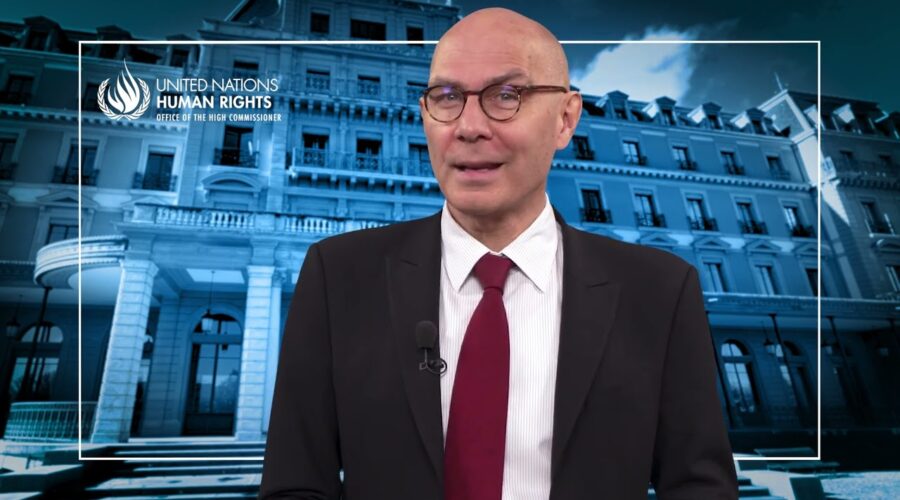
In April 2023, the UN High Commissioner for Human Rights, Volker Türk, formally launched his vision of a human rights economy. Below is a compendium of resources from the Office of the United Nations High Commissioner for Human Rights (OHCHR) that answer the question: how can we build economies that advance human rights, human dignity, peace and justice?
We need to dismantle the architecture of inequalities, and rebuild our economies with an architecture that enhances human rights – and therefore facilitates trust in government; sustainable development; and peace.
Contents
- About the human rights economy
- Operationalizing the human rights economy
- Key documents and reports
- Statements
- Meetings and events
- Podcasts and videos
About the human rights economy
In April 2023, the UN Human Rights Chief formally launched his vision of a human rights economy.
A human rights economy centres people and the planet in economic, social, and environmental policies, plans and programmes and aims at ensuring that all economic, industrial and trade policies, investment decisions, consumer protections and choices, as well as business models, are firmly guided by human rights norms and standards.
It intentionally means eliminating discrimination, empowering groups left behind and reducing inequalities by investing in rights (ie. economic, social, to a healthy environment, to development, and others), and dismantling structural barriers and impediments to equality, justice, sustainable growth and shared prosperity.
At the national level, a human rights economy can be pursued through a variety of pathways, including:
- Allocating the maximum of resources through budgets and taxation to meet the State’s commitment to health care, social protections, quality education, clean water, housing and other fundamental rights
- Protecting the fiscal space for human rights for countries in situation of debt distress
- Investing in care and support systems anchored in human rights
- Enshrining human rights at the core of trade agreements so that they offer significant opportunities to accelerate inclusive and sustainable development and growth for all;
- Reconciling economic growth with climate and environmental action and developing new metrics that measure economic success beyond GDP
Finally, ensuring transparency and accountability principles and fostering participation and empowering groups left behind are vital enablers for all the pathways mentioned above.
Building human rights economies at the national level will also require transforming the international financial architecture and global economic governance in what the UN Secretary-General has called “a giant leap towards global justice.”
In particular, it means:
- reforming the global debt architecture to make it fairer so that it proactively supports implementation of Human Rights and Sustainable Development Goals (SDGs)
- reforming the mandates of the international financial institutions so that they align their operations and conditionalities with States’ existing human rights obligations
- shifting towards more inclusive and effective international tax cooperation to combat tax avoidance and evasion and substantially increase the capacity of countries to mobilize domestic resources to invest in human rights and SDGs.
See: Reforming the international financial architecture
Operationalizing the human rights economy
OHCHR established the Surge Initiative in late 2019 to respond to galloping inequalities, the slow-paced implementation of the SDGs, and growing social unrest. The outbreak of the COVID-19 pandemic, within months of the launch, lent a compelling urgency to the initiative.
Following the continuous deterioration of the socioeconomic environment and the need to intensify efforts to reverse trends, the Office decided in 2024 to make the promotion of a human rights economy one of the six strategic directions of its new UN Human Rights Management Plan and to keep strengthening its efforts and focus on:
- Providing specialized advice and analysis to operationalize ESCR, as relevant to furthering the goals of the 2030 Agenda for Sustainable Development and curbing economic and other inequalities, including through macroeconomic policies anchored in human rights norms and standards;
- Applying a human rights-based approach to macroeconomics and advising on medium- to long-term human rights economic policies;
- Maximizing the findings and recommendations of the UN human rights mechanisms by translating these into strategic operational options to inform country development policies, plans and programmes;
- Contributing to the 2030 Agenda LNOB pledge by prioritizing engagement that aims to curb economic and other inequalities, including through addressing data and budgetary gaps and analysis; and
- Engaging with the new generation of United Nations Sustainable Development Cooperation Frameworks and Common Country Analyses to implement the vision of the UN Secretary-General’s Call to Action for Human Rights that compels the UN system to seize the generational opportunity to build a more equitable world.
- Engaging with the process set out by the Pact for the Future (action 53) for the development of measures that complement and go beyond GDP, to ensure their alignment with human rights norm and principles.
Partnerships and collaborations
Support for the human rights economy has been increasing over recent years, including among State authorities.
They have acknowledged it in several resolutions and statements at the Human Rights Council:
- The first time was in 2023, with resolution A/HRC/RES/53/28, which — together with resolutions 52/14 and 54/22 — increased UN Human Rights resources to fight poverty and address inequalities, to integrate human rights in the realization of the 2030 Agenda, and to advance economic, social and cultural rights, respectively.
- In 2025, the resolution A/HRC/RES/58/9 underscored the importance of “designing and implementing economic policies that advance the realization of human rights for all”, as well as the joint statement delivered by Honduras (on behalf of Bahamas, Bahrain, Bolivia (Plurinational State of), Chile, Maldives, Mongolia, Panama, Spain) that underscores support for the Human Rights Economy and the work of the Office in this regard.
- In 2026, the renewed resolution on Human Rights and the 2030 Agenda (A/HRC/61/L.28) introduced an explicit reference to the human rights economy. This represents the second explicit such mention by the Council, reflecting sustained and increasing recognition of the concept.
A special event brought together in Geneva representatives from Member States, (along UN entities, civil society, and leading experts) toreimagine economies through human rights lens. The discussion generated strong momentum for advancing a Human Rights Economy as a powerful way to tackle inequality. Seven Member States took the floor with compelling interventions, sharing concrete experiences and practical examples of how human rights can drive more inclusive and resilient economic policies: Impact Exchange 2025.
In a critical development for OHCHR’s efforts at pioneering the conceptual and operational underpinnings of a human rights economy, OHCHR has also built the following partnerships:
In November 2024, ILO and OHCHR Principals reaffirmed their commitment to deepening collaboration on a wide range of socio-economic and business-related issues. In particular human rights economy was identified as a key pathway to promoting social justice, through the realisation of labour rights and social protection, under the shared vision of the Global Coalition for Social Justice (GCSJ). Following a dialogue hold in November 2024, OHCHR and the ILO Principals agreed on a joint framework on the human rights economy, offering a clear value proposition for tripartite constituents. This framework was presented to social partners on the World Day of Social Justice and later at the annual GCSJ Forum on 12 June 2025.
The Office has also been engaging with a wide range of civil society organizations that have advocated that this idea that recognition of human rights obligations should be at the heart of economic-policy making. See for example, this joint civil society factsheet produced by the Center for Economic and Social Rights, GI-ESCR, Human Rights Watch, Amnesty International and the Tax Justice Network, amongst others. See also CESR’s publication on “A Rights-Based Economy: Putting people and planet first“.
Another institutionalized partnership is with the New School’s Institute on Race, Power and Political Economy. This partnership has represented a unique initiative aimed at developing scholarship and economic policy-making, and to develop programs with a diverse array of stakeholders in support of evidence-based policy solutions to reduce inequalities and poverty towards achieving human rights for all without discrimination.
In 2021, OHCHR and the Raoul Wallenberg Institute for Human Rights (RWI) have partnered to advocate for a human rights economy, including by advising the UN system, governments and other partners on the design of economic policies that respect, protect and fulfill human rights. See this recently published book: Human Rights Economies and Subnational Governance: Theory and Practice.
Examples of country work
A key way OHCHR works towards the implementation of human rights economies is by providing financial and technical support to its country and regional offices to implement seeding-change projects. These projects are undertaken in close collaboration with states authorities, UN Country Teams (UNCTs), UN Resident Coordinators (RC) and RC economists, civil society, local communities, rights-holders, prominent economists and academia, and other key stakeholders including, for example, international financial institutions. Since 2019, the Surge Initiative has provided support to over 80 of these projects globally.
See below for recent accounts of the main achievements and impact:
Final 2025 Surge Initiative report: “Seeding Change for a Human Rights Economy – Unlocking the Potential of Human Rights to Accelerate Achievement of the 2030 Agenda.” This report presents a compilation of examples of some of the most impactful human rights economy country work undertaken between 2020 and 2024 by OHCHR country and regional presences with the financial and technical support of the Surge Initiative, and in collaboration with States, UN and other partners. The examples span work on human rights-based budget, tax and debt analyses, anchored in assessments of ESC rights, with leave no one behind considerations cutting across.
Sharing in action
- North Macedonia: Leaving No One Behind Analysis, 2025
- Eswatini : Citizen Engagement on the Right to Food in Eswatini, 2025
- Kenya: Human Rights-Based Analysis of Kenya’s Budget, 2023-2024, 2025
- Zambia: Seeding-Change: A study to Advance the Rights to Food and Education in Zambia, 2023
- Southern Africa region: Advocacy Brief and an Infographic – An Intersectional Approach to Socio-Economic Data in Southern Africa – Leveraging Data to Leave No One Behind, 2023
- Jordan: Domestic Resource Mobilization: A Human Rights-Based Approach to Tackling Inequalities in Jordan – 23 March 2023
- Chad: The Right to Food and the Herders-Farmers Conflict in Chad, 2023
- Guinea-Bissau : Human Rights‑Based Analysis of Guinea‑Bissau’s Budgets from 2016 to 2022 (English | Portuguese), 2023
- Serbia: Tool For The Introduction Of The ‘Leave No One Behind’ Principle Into Legislative And Strategic Acts Of The Republic Of Serbia – 26 September 2022, 2022
Stories
- Impact Exchange: Reimagining economies through human rights
- Serbia’s Crvena Zvezda: A Roma victory against eviction – 9 February 2024
- In Serbia, data mapping drives water revolution for Serbian Roma community – 25 January 2024
- In Paraguay, social security creates safety nets and builds rights for all – 26 September 2023
- Supporting a human rights economy in Kenya – 26 April 2023
- “Our voices are being heard” – 30 September 2022
- People share priorities in first-ever review of Guinea-Bissau’s sustainable development goals – 14 July 2022
- Towards more land access and greater protection for indigenous peoples in Costa Rica – 7 December 2021
Key documents and reports
- The Human Rights Economy Discussion Paper: English | Español
- Vision of the Office of the United Nations High Commissioner for Human Rights for reinforcing its work in promoting and protecting economic, social and cultural rights within the context of addressing inequalities in the recovery from the COVID-19 pandemic – July2023
- Surge Initiative 2023 Info flyer
- Human Rights Mainstreaming Fund Final Report 2024
- Human Rights Council report – A/HRC/51/20 – Promoting and protecting economic, social and cultural rights within the context of addressing inequalities in the recovery from the coronavirus disease (COVID-19) pandemic – 8 August 2022
- Summary Briefs – Day 1 | Day 2 | Day 3 – Operationalizing the New Social Contract at the Country Level: Sharing Experiences of Integrating UN Values for Transformative Economic Change – 6-8 May 2021 – OHCHR, DCO,UN Women, ILO
- Checklist for a Human Rights-Based Approach to Socio-Economic Country Responses to COVID-19 – 28 July 2020
Statements
- Volker Turk at the Seventh HRC meeting on Human Rights and the 2030 Agenda – 11 February 2025:déclaration écrite | video message
- The Human Rights Economy – from concept to practical application | 28 June 2024
- Volker Türk at the Sixth HRC meeting on Human Rights and the 2030 Agenda – 18 January 2024
- Volker Türk on Rebuilding a foundation of hope through Human Rights Economy – Human Rights 75 Event – 12 December 2023
- High Commissioner Turk’s statement of 11 September 2023: Human rights and development are antidote to prevailing politics of distraction, deception, indifference and repression
- ASG Brands Kehris statement on human rights and sustainable development at a July 2023 High Level Political Forum (HLPF) Side-Event: The Rights Path – Leveraging Human Rights to Rescue the 2030 Agenda and Leave No One Behind – 13 July 2023
- Statement by UN Human Rights Chief on Human Rights Economy – 20 April 2023
- Türk calls for a human rights economy – 6 February 2023
- ASG Brands Kehris speaks at the 2023 ECOSOC Coordination Segment on transformative policies and actions – 2 February 2023
- Human rights provide useful guardrails for economic policies – 24 August 2022
- Feminist Economics and the Fight for Human Rights – 29 June 2022
- Q and A with Michelle Bachelet, UN High Commissioner for Human Rights – at the Sixty-Sixth Session of the Commission on the Status of Women, UN Women side event – 17 March 2022
- Ensuring that no one is left behind – How do we protect the poorest and most vulnerable from the crisis and empower them to realize the SDGs – 6 July 2021
Meetings and events
- Impact Exchange: Reimagining economies through human rights – 11 Dec 2025 : Seven Member States (along UN entities and civil society and experts) make compelling interventions, sharing concrete experiences and practical examples of how human rights can drive more inclusive and resilient economic policies.
- LNOB: the role of human rights in reforming sovereign debt and going beyond GDP – Seventh HRC meeting on human rights and the 2030 Agenda – 11 February 2025
- ‘Human Rights Economy: Policy Implications’ with Marlon Ochoa, Minister of Finance, government of the Republic of Hondurasand Nada Al-Nashif, Deputy-High Commissioner for Human Rights – side-event at the HRC 56th session (June 2024)
- Human rights into the international financial architecture reforms – Sixth HRC meeting on human rights and the 2030 Agenda – February 2024
- HR75 Event – Roundtable 3: The Future of Human Rights, Development and the Economy, 12 December 2023: Video | Background document
- Joint OHCHR/RWI event in collaboration with the World Human Rights Cities Forum session on Eradicating Poverty through a human rights economy– October 2023
- High Level Political Forum (HLPF) Side-Event: The Rights Path – Leveraging Human Rights to Rescue the 2030 Agenda and Leave No One Behind – 13 July 2023
- Hernan Santa Cruz Dialogue – A Dynamic Discussion on the Concept and Potential of a Human Rights Economy – 20 April 2023
- Workshop on promoting and protecting economic, social and cultural rights within the context of addressing inequalities in the recovery from the COVID-19 pandemic – 6-8 Feb 2023:
- 1st Meeting, Global prospects
- 2nd Meeting, Critical reflections on progress, challenges and the future of ESCRs
- 3rd Meeting, Measurement and elimination of poverty and inequalities
- 4th Meeting, Investing in social spending and tackling inequalities
- 5th Meeting, Strengthening OHCHR capacity to operationalize ESCRs
- Overcoming multiple crises: realising the SDGs through a human rights enhancing economy – Fifth HRC meeting on human rights and the 2030 Agenda – 19 January 2023
- Workshop – Operationalizing the New Social Contract at the Country Level: Sharing Experiences of Integrating UN Values for Transformative Economic Change – OHCHR, DCO, UN Women, ILO – 6-8 May 2021 – the Briefs are in the documents/reports part.
Podcasts and videos
‘Economies that Work for All’ Podcasts Series – Listen on: Spotify | Apple
Season #2 [2026] – the ‘How To’: practical country-examples and sectoral applications
- Walking the Talk: How Spain is building an economy that works for all – with Pablo Bustinduy, Minister of Social Rights, Consumer Affairs, and the 2030 Agenda – Spain
- Reducing Inequality : Inside Brazil’s approach to a fairer taxation that shapes redistribution – with Poliana Garcia Ferreira, General Coordinator, International Tax Cooperation, Secretariat of International Affairs, Ministry of Finance – Brazil
- Breaking with the past: Advancing a rights-based just transition in South Africa – with Dorah Modise, Executive Director of the Presidential Climate Commission – South Africa
- From ‘lost decades’ to human rights economies: Rethinking development from Sri Lanka’s experience – with Ahilan Kadirgamar, economist and Senior Lecturer at the University of Jaffna – Sri Lanka
- Homes, not assets: The case for housing first – with Leilani Farha, former UN Special Rapporteur on the Right to Adequate Housing (2014–2020), and current Global Director of The Shift.
Season #1 [2025] – the ‘What’: Human Rights Economy, Putting People and the Planet First
- Why is our economic system failing the 2030 Agenda? – with Volker Türk, High Commissioner for Human Rights
- Jayati Ghosh: Is the solution hiding in plain sight? Political choices for a new economic model
- Grieve Chelwa: Life and Debt: Why the SDGs cannot progress under austerity
- Kate Raworth: The Doughnut Economy: Promoting a development model that focuses on people and the planet
- Mariana Mazzucato: Mission-oriented economies: putting human rights at the centre
- Epsy Campbell Barr: Can economic policies promote inclusivity?
UN Transformation Series: Empowering sustainable growth through the human rights economy – featuring Todd Howland, Chief of the Development, Economic, and Social Rights Branch, OHCHR and Shahra Razavi, Director, of the Universal Social Protection Department, International Labour Organization (ILO) | UN System Staff College – October 2024
Human Rights When They Are None – with Volker Turk, High Commissioner for Human Rights – Push Back Talks – 12 June 2024
Original source: United Nations
Image credit: Human Rights Economy: Putting People and the Planet First, YouTube