The blueprint for a fairer society lies in front of us. But it requires moving away from the myth of “trickle-down” economics and the stubborn pursuit of GDP growth, writes Kate Pickett for the LSE.
“We are at times too ready to believe that the present is the only possible state of things.” These words of Marcel Proust, which I re-encountered in a printmaker’s studio in York, are a vital reminder to hold onto hope in these dark political days. Too often, talk about building a good (or even a slightly better) society are met with the charge that such optimism is transgressive, “wishy-washy”, or hopelessly utopian. Critics suggest that the status quo, with its widening inequality and fraying social safety nets, is the only realistic way to organise a modern economy; that “there is no alternative”.
But as a social epidemiologist, my trade is evidence, not just ideology, and the evidence tells a different story. A good society need not be a distant mirage; the proof of concept is already functioning, albeit in fragments, right across the globe.
The “fantasy society” is already here
In my book, The Good Society and How We Make It (Bodley Head, 2026), I draw extensively on a concept created by the political economist, Andrew Simms, called “Goodland”. Simms imagines a society where, among other seemingly utopian features, the constitution is written by citizens, the president lives on the national average wage, the banking system is mutually owned, and the wellbeing of people and planet is prioritised over raw economic output or GDP.
Crucially, every one of these features already exists in the real world. Iceland managed its financial crisis by holding banks accountable rather than bailing them out; Finland’s education system consistently produces high-achieving, happy children by prioritising curiosity and wellbeing over an exam-factory culture; Costa Rica has enshrined the protection of ecosystems above all other laws; and Norway and Denmark demonstrate that high-trust, low-inequality societies aren’t just possible – they are more stable and prosperous.
We can play “fantasy society” as if we are a fantasy football manager, picking the best players from real teams to build the strongest possible squad. When we do this, the question is no longer whether a good society is feasible but instead about the barriers to implementation in our own countries.
Inequality: The bedrock of dysfunction
The primary barrier, as Richard Wilkinson and I argued in The Spirit Level (Penguin, 2009) and The Inner Level (Penguin, 2018), is economic inequality. Our research has shown consistently that in more unequal societies, almost every social and health problem, from infant mortality and obesity to homicide rates and imprisonment, is significantly worse. Our most recent analysis also finds links between inequality and environmental problems, the erosion of trust and democracy, and racial and gender inequalities.
This isn’t just theory; these are robust correlations supported by decades of data and causal analysis. In more equal Scandinavian countries, over 60% of people trust one another; in more unequal Greece or Portugal, that figure drops below 20%. Inequality creates chronic social stress, driving status anxiety and consumerism as people struggle to prove they aren’t themselves second-class. By reducing the gap between rich and poor, we wouldn’t just help those at the bottom, we could improve the quality of life for everyone.
Imagine you had to design a society without knowing your own place in it… Would you design a system where a tiny elite accumulates unimaginable wealth while one third of children are growing up in poverty?
To those who would still claim that dreaming of such change is transgressive, I offer John Rawls’ “veil of ignorance”. Imagine you had to design a society without knowing your own place in it: you wouldn’t know your age or your gender, nor your social class, level of intelligence or your wealth. From this so-called original position, would you design a system where a tiny elite accumulates unimaginable wealth while one third of children are growing up in poverty and one in 45 children in towns like Blackpool are in the care system? Of course not. You would design a society rooted in fairness and prevention.
Closing the “action gap”
We don’t have an evidence gap. Nor, if we allow ourselves to imagine a good society, do we have a vision gap. But we certainly have an action gap. My shelves are full of blueprints for tackling poverty, transforming capitalism, and mitigating the climate emergency. These reports are often cited in Parliament and then left to gather dust while politicians wing it or engage in short-termism or pander to vested interests.
Yet the fact remains: the type of society that we build is a choice. Building a good society requires us to move away from the trickle-down myths of neoliberalism and stubborn pursuit of growth in GDP and toward a wellbeing economy – a movement already joined by countries like Iceland, New Zealand, and Scotland.
It is not utopian to want a society where children flourish, where care is a right rather than a financial burden, and where justice focuses on rehabilitation over retribution. It is simply the most rational, evidence-based path forward. We have the blueprints; it is time we started making.
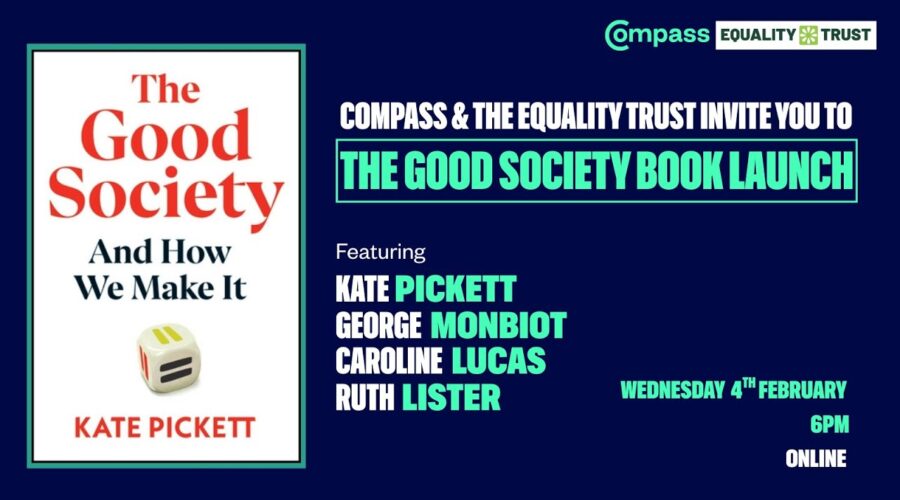
The Good Society and How We Make It by Kate Pickett is published by Bodley Head and is out now.
Original source: LSE
Image credit: ‘The Good Society’ Book Launch with Kate Pickett, George Monbiot, Caroline Lucas and Ruth Lister, YouTube