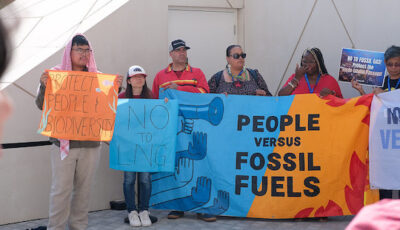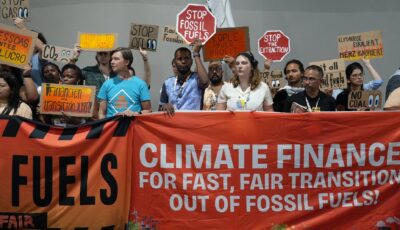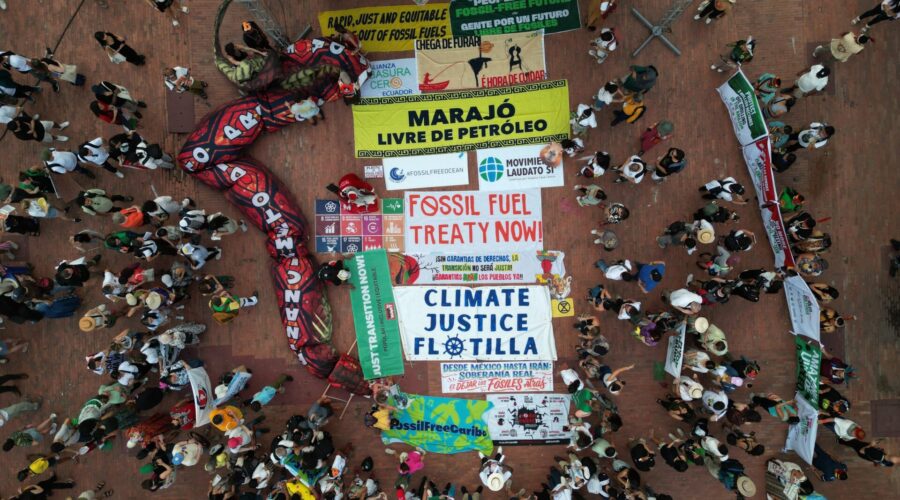
Governments have been asked to develop national “roadmaps” setting out how they will end the production and use of fossil fuels, after a landmark climate meeting involving nearly 60 countries. Reported by Fiona Harvey and Jonathan Watts for the Guardian.
The voluntary plans will form the bedrock of a new initiative to wean the world off coal, oil and gas, the focus of two days of intensive talks in Colombia this week.
The approach marks a departure from the annual UN climate negotiations, which have run for more than three decades even as greenhouse gas emissions have continued to rise. Most of the world’s biggest emitters are absent from the group of 59 participants, though other countries are being invited to join.
Irene Vélez Torres, Colombia’s environment minister and chair of the talks, said: “We decided not to resign ourselves to an economy built on the destruction of life. We decided that the transition away from fossil fuels could no longer remain a slogan but must become a concrete, political and collective endeavour.
“When people look back on us from the future, they will not remember only this conference. They will remember whether or not we rose to the challenge of our time.”
Colombia and the Netherlands, co-hosts of the inaugural conference on transitioning away from fossil fuels, convened discussions on trade, debt, producer countries’ dependence on fossil fuel exports and ways to reduce demand. In the preceding days, activists, Indigenous leaders, scientists and other experts gathered in Santa Marta to discuss the social and economic impacts of fossil fuels and ways to curb demand.
With the US, China, India, Russia and petrostates such as Saudi Arabia, Qatar and the United Arab Emirates absent, attendance was limited to countries willing to commit to a phaseout. This “coalition of the willing” represents more than half of global GDP, nearly a third of energy demand and a fifth of fossil fuel supply.
Almost half of the countries are fossil fuel producers, and will be expected to set out how they intend to wind down output. However, there are no stipulations on how the plans should be structured, nor deadlines for completing the transition.
Colombia published a draft roadmap during the conference and set up a scientific panel to advise countries. On Tuesday, France became the first developed country to release a national roadmap to phase out fossil fuels.
Stientje van Veldhoven, the Netherlands’ minister for climate and green growth, told the Guardian: “We see the roadmaps as the tool for the ambition with which they came here [to transition away from fossil fuels]. There will be different speeds between countries – we should allow for this and acknowledge that countries start from a different position, have different challenges, so that it cannot be one size fits all.”
While countries already publish climate plans under the Paris agreement, known as nationally determined contributions (NDCs), Vélez said these were not sufficient to serve as roadmaps because they addressed only countries’ domestic greenhouse gas emissions, allowing fossil fuel producers to sidestep the climate impact of their exports.
Participants also agreed to support poorer countries with the expertise needed to develop roadmaps, to scrutinise fossil fuel subsidies, and to collaborate on trade policy and financial reform – including helping poor and vulnerable countries tackle debt and raising the finance needed to make the transition.
A second conference will take place early next year on the Pacific island of Tuvalu, co-hosted by Ireland. Tuvalu’s minister for home affairs, climate and environment, Maina Talia, said: “We are encouraging governments and states [to draft roadmaps before the next conference], because if they come without concrete roadmaps, we are losing an opportunity. But, at the end of the day, they are voluntary.”
The Santa Marta conference was prompted by frustration with the UN climate summits, where consensus rules have often allowed fossil fuel interests to block direct discussion of the need to phase out coal, oil and gas. However, participating governments have said they will work closely within the UN system to help bring about global progress on the climate at the Cop31UN climate conference in November.
Tzeporah Berman, the founder and chair of the Fossil Fuel Non-Proliferation Treaty Initiative, said: “Santa Marta represents a historic breakthrough – the first time we bring together a group of nations willing to act. We are building a coalition of ambitious countries willing to lead and break the consensus deadlock that has paralysed concrete action on fossil fuels in the UN negotiations.”
Observers praised the constructive nature of the Santa Marta talks. Fatima Eisam-Eldeen, from the University of Barcelona, said: “For too long, multilateral climate forums have felt like rooms where everyone speaks, but no one understands. Santa Marta broke that pattern. It spoke the language of hope.”
Kirtana Chandrasekaran, a climate justice and energy programme co-coordinator at Friends of the Earth International, called for governments to replace fossil fuels with renewable energy, given added impetus by the current oil crisis.
“[Avoiding climate breakdown] requires systemic change to the current energy model – away from fossil fuelled corporate dominance and towards bottom-up, decentralised renewables that ensure energy sovereignty for all,” she said.
Original source: The Guardian
10 lessons on ending the fossil fuel era
After a landmark climate meeting in Santa Marta, Colombia, where nearly 60 countries gathered to work out how to end the production and use of planet-heating fossil fuels, what have we learned?
1. Liberation lifts the spirits
The single most important thing to come from the first Transitioning Away from Fossil Fuels conference, in Santa Marta, has been a change of mood. Whereas the UN’s annual climate summits, or Cops, can often feel stuck and frustrating, with countries circling the same topics without resolution, nearly every delegate in Colombia felt liberated.“The mood here in Santa Marta is euphoric,” said Tzeporah Berman, the founder and chair of the fossil fuel non-proliferation treaty initiative. “After years stuck in endless debates about whether to phase out fossil fuels, finally we are focusing on the how. We are no longer fighting for recognition of the problem, but creating solutions. It’s like watching a dam break – all that pent-up experience, knowledge and passion suddenly flowing into concrete ways to phase out dirty fuels. The hope is contagious.”
2. Science has to come first
In a world of climate denial and misinformation, Santa Marta was a shining example of science-led decision making. Hundreds of experts, academics and scientists inspired and informed the launch of three major initiatives on the energy transition.
It reminded many participants of an earlier, more enlightened age of global climate negotiations, which would always start with an update of the latest science. Over the years, however, oil-producing countries such as Saudi Arabia have vetoed or watered down UN science warnings, while introducing controversial solutions, including offsets and carbon capture and storage, that have been promoted by the petroleum industry as an excuse to continue expanding production. At Santa Marta, delegates called these “false solutions” and focused on the core of the problem: eliminating fossil fuels.
3. Producers must be in the spotlight
Climate activists have long argued the Cop process has been crippled by a focus almost solely on the demand side of the problem. The responsibility of emission cuts was dumped on to consumers, while oil, gas and coal companies were given free rein to ramp up production and profits. At Santa Marta, the balance was shifted back to the supply side. Some speakers said the majority of the world’s emissions, which continue to break records almost every year, were released by the drilling, processing and transportation of fossil fuels.
Rather than condemning petrostates, this was treated as an unhealthy dependency and ways were examined to break the pattern of addiction.
4. Global south debt must be tackled
The urgent need to address the debt crisis was one of the clearest messages to emerge from Santa Marta. Many countries in the global south that want to invest in renewables are unable to do so because they spend a huge proportion of their foreign exchange earnings on high interest repayments and imports of fossil fuels.
Banks and bond markets provide low-interest loans to fossil fuel industries – most of which are based in wealthy nations – without accounting for the associated risks of climate instability and stranded assets. Many participants at Santa Marta said this showed an energy transition had to come with changes to the global financial architecture, as well as the redirection of government subsidies away from the petroleum industry and towards renewables and debt reduction.
5. Not everyone agrees on everything
There were few open disagreements among the “coalition of the willing” assembled at Santa Marta, but there are differences of opinion on how to achieve the desired end of a fossil-fuel-free society. The Colombian hosts set no guidelines on what, if any, legal framework should be adopted.
One longstanding proposal is for a new fossil fuel non-proliferation treaty, which would be modelled along the lines of human rights treaties and the international land mine treaty. But this is anathema to some countries, who argue that the world already has global climate agreements and just needs to put them into action.
There are also a confusing number of existing pacts and pledges, reflecting the complexity of shifting the global economy to a low-carbon footing and the desire of some countries to stamp their identity on projects they are funding. The danger is that, instead of working harmoniously together, nations could splinter into smaller groups.
6. Roadmaps need a destination and a deadline
One word that came up time and again was roadmap, or in other words, a clear plan for transitioning away from fossil fuels. One global roadmap will not be enough. Every country will need its own, and there are two key requirements: the destination, which should be a full phase-out of fossil fuels; and a timetable, because with global temperatures continuing to break records, time is fast running out.
7. Governments must be free to govern
Investor-state dispute settlement is a legal mechanism contained in many trade agreements, which allows companies and financiers to sue governments in secret tribunals for their policies. It has been used by fossil fuel companies to sue governments that resolved to reduce dependency on coal, oil or gas, or enacted measures boosting renewables: companies have demanded and, in at least $100bn worth of cases, received compensation for loss of earnings.
Climate activists, experts, and many developing countries want an end to ISDS, which they say is a serious legal and financial obstacle to a cleaner world.
8. Critical minerals will be critical
If the world is to transition away from fossil fuels, there must be a new renewable energy economy to transition to. That will require the construction of billions of wind turbines, solar panels, electric vehicles and batteries. All of this requires components made of critical minerals – metals such as copper, cobalt, nickel and harder-to-get materials such as gallium, germanium and niobium.
Mining for some of these has resulted in horrific human rights abuses and despoliation of natural landscapes. Activists in Santa Marta raised concerns over the plight of workers and Indigenous people, and the need for proper regulations and a clean, fair transition for local communities.
9. Indigenous rights must be respected
Indigenous peoples protect the vast majority of the world’s remaining terrestrial carbon sinks and areas of biodiversity, but have long struggled to secure a seat on the top table of UN climate negotiations. At Santa Marta, for the first time, Indigenous representatives drew up their proposals in an autonomous debating space and participated in the high-level segments.
It did not satisfy everyone, but it gave leaders an opportunity to tell ministers directly that they needed to pay more heed to Indigenous knowledge, the protection of Indigenous rights and the importance of nature in the transition. “Our territories are fundamental to maintaining life on this planet. Where our rights are respected, nature is protected,” said Oswaldo Muca Castizo, the general coordinator of the Organization of Indigenous Peoples of the Colombian Amazon.
10. Tuvalu is the next step
Translating the feel-good vibe of Santa Marta into concrete proposals will be the task of the next conference, which is expected to take place in Tuvalu, co-hosted by Ireland, in early 2027.
Fiona Harvey is an environmental editor at the Guardian
Jonathan Watts is the Guardian’s global environmental writer.
Original source: The Guardian
Image credit: Just Fossil Fuel Transition, X